
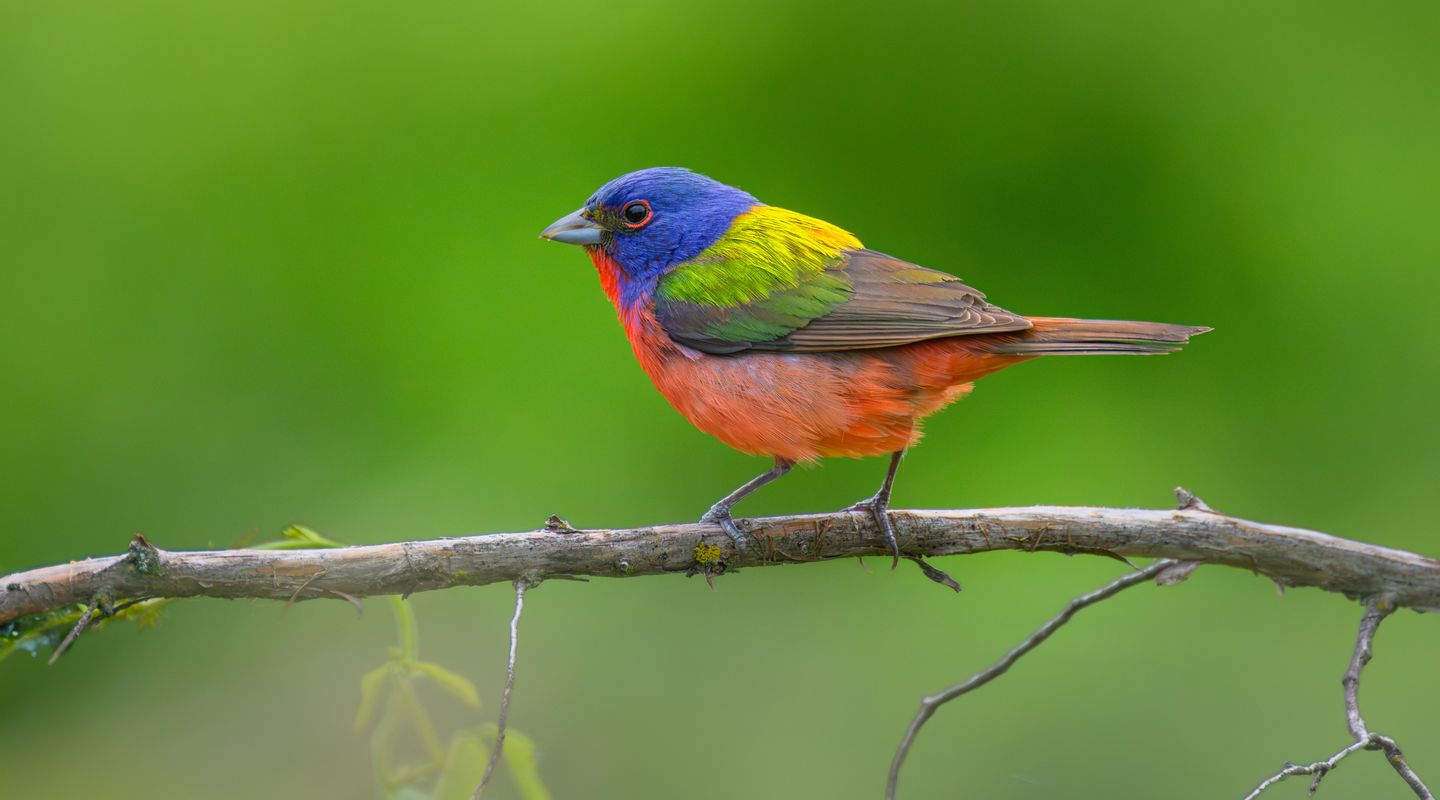
There's a bird at Bartram's Garden right now that has no business being in Philadelphia in February.
A male Painted Bunting — electric blue head, stoplight-red breast, lime-green back — has been spotted again at the 50-acre West Philly park along the Schuylkill River. If you've never seen one in person, think of the most aggressively colorful bird you can imagine, then double it. The French call it nonpareil — "without equal." That tracks.
What makes this sighting remarkable isn't just the bird itself. Painted Buntings are native to the southern United States, Mexico, the Caribbean, and Central America. They're supposed to be wintering somewhere between Florida and Honduras right now. Philadelphia is not on the itinerary.
And yet, here we are — for the fourth winter in a row.
Bartram's Unlikely Regular
According to Bartram's Garden, this is likely the same male bird returning each year. Painted Buntings, like many migratory species, are creatures of habit. Once they find a winter spot that works, they come back. Most birds pick southern Florida or the Gulf Coast. This one picked Southwest Philly.
The bird has been reliably spotted along the grassy meadow near Bartram's Mile Trail at the north end of the park, close to the Schuylkill River. Word has spread through local birding chat groups on Telegram and social media, drawing crowds of binocular-wielding Philadelphians to the gardens hoping for a glimpse.
Why It Matters
Vagrant birds — species that show up outside their normal range — are always exciting. But a vagrant that returns four years running starts to tell a bigger story. Climate patterns are shifting. Winters in the Philadelphia region are warmer than they were 20 years ago. Species ranges are drifting north. Black Vultures, Red-bellied Woodpeckers, and Northern Mockingbirds have all expanded into the Philly metro area over recent decades.
Is the Bartram's Painted Bunting a one-off anomaly, or an early signal of something larger? Ornithologists aren't ready to draw sweeping conclusions from a single bird, but the pattern is hard to ignore.
How to See It
If you want to chase this bird — and you should — here's what to know:
Where: Bartram's Garden, 5400 Lindbergh Blvd, Philadelphia. Head to the north end of the park along Bartram's Mile Trail near the Schuylkill River. The meadowy, grassy areas are where most sightings have been reported.
When: Early morning is best. The bird has been feeding on grass and weed seeds in the meadow. Be patient — despite the absurd coloring, Painted Buntings like to stay low in dense cover and can be surprisingly hard to spot.
What to bring: Binoculars are essential. If you don't have a pair, Bartram's Garden has loaners available at the welcome center. A camera with any kind of zoom will help you grab a photo, but don't stress about gear — this is about the experience.
Etiquette: Give the bird space. Don't play calls or recordings to lure it out. Stay on the trails. If a crowd has gathered, be patient and share the viewing spot. This is a public garden and a community moment.
About the Painted Bunting
For a bird this flashy, the Painted Bunting is surprisingly elusive. Males don't get their full technicolor plumage until their second year — before that, they look like plain green birds, nearly identical to females. They're part of the cardinal family, which makes them distant cousins of the Northern Cardinal you probably see at your feeder every day.
There are two distinct populations in North America. The eastern population breeds along the coast from North Carolina to Florida and winters in southern Florida and the Caribbean. The western population breeds in Texas and the south-central states and winters in Mexico and Central America. Both populations are declining — down roughly 50% since the 1960s — due to habitat loss and illegal trapping for the pet trade, which remains a serious problem in parts of Mexico, Central America, and the Caribbean.
That makes every sighting a little more precious.
The Bigger Picture
I got into birding about a year ago. My co-founder Mark Gallant — a 486-species lister and wildlife photographer — showed me what was possible when you actually start paying attention to the birds around you. My first real "holy crap" moment was a Bald Eagle in Bar Harbor, Maine. Since then, I've been hooked, birding across South Jersey and at Longwood Gardens near my home in Kennett Square.
But this is what I love about birding: a world-class bird sighting is happening right now, for free, at a public garden in West Philadelphia. You don't need a plane ticket or expensive gear. You just need to show up and look.
That's what Roost is about. Every birder starts somewhere — at a feeder, on a trail, in a public garden staring at something impossibly colorful that shouldn't be there. Find your roost.
---
Have you spotted the Painted Bunting at Bartram's Garden? We'd love to hear about it. Tag us or share your photos — this is exactly the kind of community moment we built Roost for.
Cover photo by Shiva Shenoy via Flickr, CC BY 2.0